
"We Already Have Baffles." Here's Why That Might Not Be Enough.
Welded baffles redirect surge force into the tank and truck. Floating baffles prevent it from ever organizing into a dangerous wave. Here's the mechanism difference, the independent research behind it, and what it means for a tank that's already baffled.
Some Tank Trucks Already Have Baffles
Welded steel baffles, partial walls with openings that let liquid pass through but slow it down, have been standard for decades. Unlike a solid partition, a baffle doesn't seal the tank into separate compartments; it stays inside one continuous volume of liquid and spreads surge energy more evenly across the tank shell instead of letting the full force of a surge slam into the front bulkhead. So when surge comes up, the natural response is: "We've already got that covered."
Here's the problem: welded baffles and Surge Busters aren't doing the same job. One redirects force. The other removes it. That's not a difference of degree, it's a difference in kind, and it's the difference between protection in one direction and protection in every direction.
The Core Difference: Redirect vs. Prevent
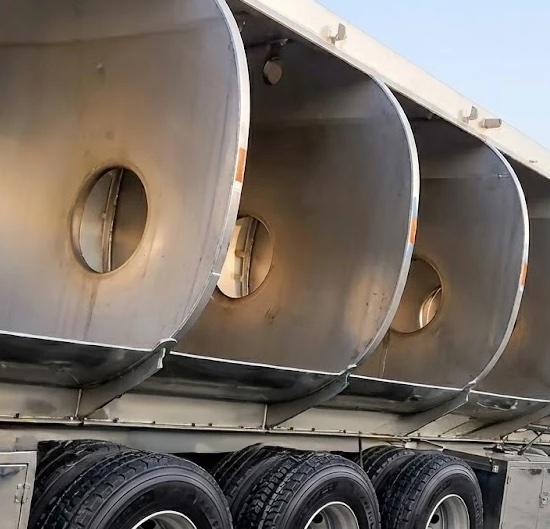
A welded baffle has openings that let liquid pass through, just more slowly than it would with no baffle at all. When the liquid surges against it, the baffle resists and redistributes the flow, spreading the impact across the tank shell instead of letting it concentrate at the front bulkhead. The force doesn't disappear, though: it still transfers through the baffle into the tank shell, and from the tank shell into the truck frame, suspension, and brakes. The baffle did its job, spreading the force out; the force just found a new path.
Surge Busters don't stand in the way, either. They solve the problem differently. On a flat, steady highway, the liquid inside the tank already sits in small, disorganized eddies, harmless motion with no coherent direction. It's braking, a turn, or any change in speed or direction that gives that energy the chance to organize into one large, resonant wave, and that's the moment surge becomes dangerous. Surge Busters float freely in the liquid and introduce competing wave frequencies, a phenomenon called Harmonic Dissonance (destructive interference between the competing frequencies), that prevent the liquid from ever organizing into that single wave. The energy stays fragmented, dissipated as turbulence inside the liquid, before it ever reaches the tank wall.
One mechanism redirects force. The other keeps it from ever forming in the first place.
The Research Behind This
This isn't a claim unique to Surge Busters. It's a documented finding across multiple independent studies of baffle design:
- Kang et al. (Ocean Systems Engineering, 2019) found that floating baffles suppress sloshing more effectively than fixed baffles, the exact mechanism comparison this page describes.
- Xie & Zhao (Physics of Fluids, 2021) confirmed that energy dissipation requires baffle movement, not rigidity, and that fixed baffles redirect force into the tank wall rather than eliminating it.
- Kolaei, Rakheja & Richard (2014 to 2017), in a series of papers on 3D liquid slosh, found that fixed baffles provide no protection against lateral (side-to-side) slosh loads, only longitudinal.
Note on Xie & Zhao (2021): this paper studies actively, algorithmically controlled baffles (via reinforcement learning), a powered mechanism, not the passive floating design Surge Busters use. It supports the broader principle that baffle motion affects damping, not a direct comparison to Surge Busters' specific mechanism.
→ See the full citation library: The Independent Research Library
One Direction vs. Every Direction

Welded baffles are installed across the tank, addressing front-to-back surge, the kind that happens during braking and acceleration. They do nothing for lateral surge, the side-to-side motion that happens during cornering, lane changes, and the evasive maneuvers most directly tied to rollovers.
Surge Busters float freely in three dimensions. As the liquid moves, front-to-back, side-to-side, or both at once during a braking-in-a-turn maneuver, the baffles move with it, in whatever direction the surge is actually happening.
The cancellation math itself, floating elements oscillating out of phase and canceling each other's force, works the same way regardless of direction. The 96.7% figure is what that math produced in Budwig's tilt-table test, measured fore-to-aft. The exact percentage of side-to-side force has not been separately measured.
A welded baffle is built for one scenario. Surge doesn't only happen in that scenario. And although welded-in baffles do facilitate transfer of surge force to all of the other components of the entire delivery unit, in the final analysis only Surge Busters eliminate the force almost entirely. That is the real difference.
The Numbers, Side by Side
Documented engineering data across five of the largest tank trailer manufacturers in the industry, Polar, Heil, Tremcar, Beall/Wabash, and MAC LTT, consistently shows welded baffles reducing front-to-back surge by 35% to 60%, depending on manufacturer and fill level. These are the companies that build the tanks, and it's worth being precise about what that number actually measures.
That reduction describes less liquid movement inside the tank itself, not less force reaching the truck. A welded baffle slows the liquid and spreads its impact across the tank shell rather than stopping it outright, but the force doesn't stop there either. It transfers through the baffle into the tank shell, and from the shell into the frame, suspension, and brakes. "Reduced surge in the tank" and "less force hitting your truck" are not the same claim, and the industry's own numbers are describing the first one, not the second.
Read that way, this isn't really a competing number to beat, it's an admission. Five of the largest engineering organizations in this industry, with decades of combined experience, have only ever managed to redistribute surge force in different ways. None of them eliminate it. Surge Busters, independently tested by the University of Idaho (2004), reduce the force itself by 96.7% fore-to-aft, by a mechanism that isn't limited to that direction, which is a categorically different claim than anything welded-baffle engineering has produced.
| Category | Welded Baffles (typical, 2 baffles) | Surge Busters |
|---|---|---|
| Mechanism | Redirects force into tank wall / truck structure | Prevents the wave from organizing; dissipates energy as turbulence within the liquid |
| Directions addressed | Front-to-back only | All directions by mechanism (fore-to-aft is the only magnitude independently measured) |
| In-tank movement reduced | 35 to 60% (front-to-back only, documented OEM range) | N/A, not the relevant measure |
| Force actually eliminated from the system | 0%, redirected into tank/truck, not removed | 96.7% fore-to-aft (independently tested, Budwig 2004); side-to-side not separately measured |
| Lateral / rollover protection | None | Yes, by mechanism (magnitude independently confirmed fore-to-aft only) |
| Installation | Welding, tank modification, downtime | Drop-in through existing access port, no welding |
| Tank compatibility | Built into original construction; aftermarket welding into poly/roto-molded tanks risks structural fatigue | Poly, stainless, fiberglass, aluminum, lined tanks, no modification |
| Effect on truck components | Force still reaches frame, suspension, brakes | Measured 51.9% reduction in G-force on truck frame (LSC fuel oil delivery study) |
| Transferable to another tank | No, permanent | Yes |
OEM welded-baffle range (35 to 60%) sourced from internal engineering summary compiled from Polar, Heil, Tremcar, Beall/Wabash, and MAC LTT documentation; not yet a published citable page. The 51.9% G-force figure is from LSC's own field study comparing two matched fuel-oil delivery trucks, see The Science Behind the 96.7% for detail.
Retrofitting Metal Tanks
If your tank doesn't already have welded baffles, welding them in is possible with metal, unlike poly tanks, but it isn't a simple add-on. Adding baffles to an existing metal tank means welding into the tank, and taking the vehicle out of service for the duration, real cost and real downtime, on a tank that wasn't originally built with baffles in mind. This is particularly expensive and adds more downtime costs with painted or vinyl-wrapped tanks.
This is one of the reasons a drop-in system makes sense even for metal tanks: it adds surge control without the downtime, cost, or structural modification that welding in baffles after the fact requires.
What This Means If Your Tank Already Has Baffles
If your tank already has welded baffles, that doesn't mean the force problem is solved. Baffles reduce in-tank movement fore-to-aft, but they redirect the force into the tank shell, frame, suspension, and brakes rather than eliminating it, and they do nothing for lateral surge. Surge Busters eliminate 96.7% of the force itself, fore-to-aft, by a mechanism that isn't direction-limited. That gap, force that's redirected rather than removed, and zero lateral protection, is exactly where surge-related wear and rollover risk live.
Surge Busters work alongside existing welded baffles. They don't replace them or require removing them, they address what welded baffles were never designed to address.
Why This Matters Especially for Plastic Tanks
Every surge cycle that isn't eliminated has to go somewhere, and for a tank, that means repeated stress on the tank wall, cycle after cycle, for the life of the vehicle. That fatigue mechanism isn't unique to plastic, it happens in steel and aluminum too, but plastic and metal don't start from the same material strength, and they don't respond to repeated stress the same way.
Ready to Get Started
→ See the independent research: The Independent Research Library
→ See the science behind 96.7%: The Science Behind the 96.7%
Order Surge Busters →