
The 5 Hidden Profit Points for Companies Transporting Liquid Loads
Chemical tankers, fuel trucks, water tankers, milk trucks, army surplus tanks, firetrucks, boats: what do all of these have in common? They regularly transport liquids that move as partially full loads, and that's only the surface. Traditionally, that energy gets managed with metal baffling welded into the tank. Surge Busters are a different approach, and they affect your bottom line in five places most people don't think to look.
What Is the Surge Buster?
Surge Busters are a dynamic drop-in baffle system, made of virgin HD polypropylene, rated to 175°F. They're easy to assemble and add to your tanks: no welding, no drilling, no tank modification.
Because they float freely instead of bolting to the tank wall, they respond to surge in every direction, not just fore-to-aft the way a welded baffle does. See Why Floating Baffles Work for the mechanism. They're easy to clean and work well with hot or cold liquids.
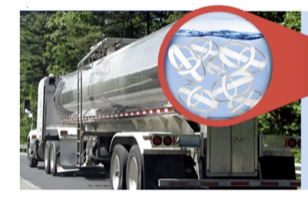
surge force reduction Budwig, University of Idaho, 2004
The 5 Hidden Profit Points below show what that number is actually worth to your operation.
The Five Hidden Profit Points
1. Driver Retention & Acquisition
The number one profit point for your operation is likely going to be your driver. How well do you retain drivers, and how easy is it to hire new ones when you need to?
One of the greatest challenges for drivers of liquid tank loads is the stress of managing all that energy on the road. Happy, less-stressed drivers are retained drivers, and personnel is one of the biggest costs in this business: keeping drivers who want to keep driving for you translates directly to lower long-term costs.

2. Operational Safety
Nearly two out of three cargo tank rollovers happen when the tank is only partially full, and rollovers aren't the whole picture: in fatal cargo tank crashes of any kind, only 26.5% involve a rollover at all, the other 73.5% come from collisions, run-off-road events, and other causes where surge force is still very much in play.
FMCSA/UMTRI, Cargo Tank Roll Stability Study, 2007Most recommendations for reducing this risk center on driver training: more awareness, more caution behind the wheel. That puts the responsibility for managing the liquid load entirely on the driver, for a physical force that isn't actually something driving skill can control once the truck is moving. Removing the surge itself removes that variable, regardless of how good the driver is.
Fewer accidents means lower repair, replacement, and insurance costs, and fewer lost or delayed loads. It also feeds directly back into Profit Point #1: safer trucks are part of what keeps drivers around.
3. Transportation Capacity
Greater usable tank capacity is a feature most people don't expect from a baffling system, but Surge Busters displace only about 8 gallons of space for every 1,000 gallons of tank capacity: less displacement than other dynamic baffling systems on the market, which means more of your tank stays usable payload.
Since some kind of baffling is a practical necessity for any partially full liquid load, the amount of capacity a given system costs you is a real, measurable line in your profit picture.
4. Maintenance
Every baffling system carries some maintenance cost. Metal baffles are welded in and need to be repaired when they're damaged, and that repair cost is high. They also don't dissipate energy, they redirect it, which means the vehicle itself absorbs more stress over time.
Surge Busters aren't attached to anything in the tank, so they can't damage it, and the energy they dissipate is energy that never reaches the truck. Less stress on the vehicle translates to lower long-term maintenance costs. Based on Liquid Surge Control's own customer base, many operators are still running their original Surge Busters after 10, 15, and 20+ years, though that's a reflection of customer experience, not an independent longevity study.
5. ROI for Required Safety Systems
If your operation regularly transports partially full liquid loads, some form of baffling isn't optional. That means the real question isn't whether to invest, it's which system gives you the best return: lower upfront and replacement cost, lower maintenance, more usable capacity, better driver retention, and fewer accidents, all at once.
Pricing depends on tank size and configuration. See current models and get a quote to run the numbers for your specific tanks.

Why This Matters to You
If your business relies on regularly transporting liquids in tanks that are frequently partially full, you need some way to manage the energy that motion creates. Surge Busters address that directly, and the effect shows up in more places in your operation than surge force alone: your drivers, your accident rate, your usable capacity, your maintenance budget, and your bottom line.
At minimum, the five points above are a useful way to evaluate your current operation and see where the largest opportunity for improvement actually is.

What You Can Do Now
It's simple. Surge Busters are easy to acquire, assemble, and install in any or all of your tanks. Contact us and we'll help you get set up on even just one tank, so you can see how it works with minimal investment.
Curious what this looks like for your fleet?Run your own Surge Force numbers first, or go straight to ordering.
Run Your Surge Force Numbers →