
Tanks Strapped to a Trailer, Not Built Into One
From a single tank on a utility trailer to purpose-built flatbeds carrying multiple large tanks side by side, this setup shows up constantly: poly or fiberglass tanks, any size, mounted to a trailer rather than integrated into a cargo tank body, hauling water, fertilizer, or any number of other liquids. Surge Busters install in any of them, no welding, no structural modification, regardless of tank material or size.
A Wide Range of Real-World Setups
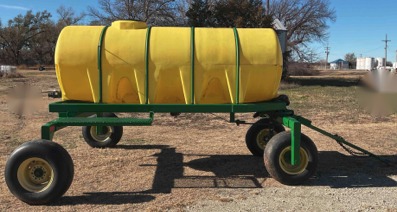
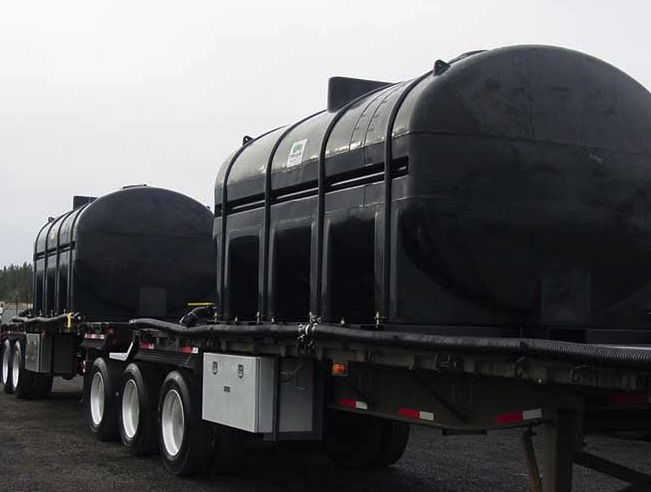
This isn't one specific scenario, it's a whole category. A single oval poly tank strapped to a small utility trailer. Two or three tanks mounted to a larger trailer. Purpose-built flatbed trailers, sometimes tandem-axle, designed specifically to carry multiple large tanks. Sizes run from a few hundred gallons to several thousand per tank. The liquid varies: water, liquid fertilizer, and other non-hazardous liquids most commonly. The tank material varies too: roto-molded poly is the most common, but fiberglass (FRP) tanks show up in this application as well, heavier and structurally stronger than poly, but still not metal.
What all of these have in common: the tank isn't a welded, integrated part of a cargo tank vehicle. It's a standalone vessel, strapped or mounted to a trailer deck.
The Vessel Itself Isn't Built to the Same Standard
DOT-specification cargo tank motor vehicles, the classes designated DOT 406, 407, and 412, are built under detailed federal design and construction requirements. Among them, under 49 CFR §178.345-8, is a requirement for engineered rollover and accident-damage protection: devices sized and strength-tested to protect the tank and its fittings in a rollover or rear-end collision. A tank that doesn't meet these requirements cannot legally be represented as a specification cargo tank, and cannot be used to haul a product that requires one.
The liquids typically hauled this way, water, liquid fertilizer, and similar non-hazardous products, generally aren't classified as DOT hazardous materials, which is almost certainly why these poly and FRP tanks can legally be mounted to a trailer with no specification requirement at all: the product being hauled doesn't trigger the requirement for a specification tank in the first place, so none of the engineering that comes with one, including rollover protection, is required either. A trailer hauling an actual DOT-regulated hazardous product would be a different case, not addressed here.
Sourced: 49 CFR §178.345 (general design and construction requirements for DOT 406/407/412 cargo tank motor vehicles) and §178.345-8 (accident damage protection). The connection to hazmat classification is a reasoned conclusion based on that regulation and general DOT hazmat classification, not a citation naming a specific product; confirm with counsel before stating it as a flat regulatory fact rather than a reasoned inference.
Real Surge Control, No Welding Required
Surge Busters are a free-floating system that drops in through an existing access port, no welding, no structural modification, and no dependence on the tank being metal or being part of a larger vehicle body. Tank material, tank size, and mounting configuration don't change whether Surge Busters can be installed. That's the actual point of this page: this is an application where surge control is genuinely available.
What Removing 96.7% of That Force Actually Changes
Surge Busters were independently tested by the University of Idaho, measuring a 96.7% reduction in surge force, fore-to-aft. Removing that much force changes three things at once: risk, less unpredictable load transferring through the hitch and into the tow vehicle on every stop and turn; safety, a shorter, more predictable stopping distance instead of a trailer still pushing forward after the brakes have already done their work; and drivability, a tow vehicle that responds the way the driver expects instead of fighting a delayed shove from thousands of pounds of liquid.
That difference is sharper behind a pickup truck than behind a semi-tractor. A pickup weighs a fraction of what a Class 8 tractor weighs, so the same surge force is a much larger share of the tow vehicle's own weight, traction, and braking capacity, exactly the setup most of these trailer-mounted tanks are towed with.
→ See the science behind that number: The Science Behind the 96.7%
What Surge Busters Do and Don't Change Here
Surge Busters address one risk factor in this picture: the surge force generated by the liquid moving inside the tank during braking, turning, or an evasive maneuver. In a trailer-mounted tank with no other surge mitigation of any kind, that force reduction matters more than almost anywhere else on this site.
Surge Busters do not make a non-specification tank meet DOT 406/407/412 engineering requirements. They do not add rollover protection, accident-damage protection, or any structural rating to the vessel itself. The tank's lack of engineered crash survivability is a separate, unaddressed risk factor that installing Surge Busters does not change.
Reducing surge force and making a vessel crash-rated are two different things. This page is about the first one only.
The Tank Material Matters Here Too
These tanks are poly or fiberglass, not metal, and neither has metal's structural capacity or response to repeated stress. Fiberglass is generally heavier and stronger than poly, but it's still not metal.
Ready to Get Started
→ See the independent research: The Independent Research Library
Order Surge Busters →