
Can You STOP the Threat of Liquid Surge?
The Mechanism →
For Repair Shops & Resellers →
How It Works
Every other surge solution redirects the force. This one removes it.
On a flat, steady highway, the liquid inside the tank sits in small, disorganized eddies: harmless motion, no coherent direction. Braking, a turn, or any change in speed or direction gives that energy the chance to organize into one large, resonant wave. That's the moment surge becomes dangerous. Surge Busters float freely and introduce competing wave frequencies, a phenomenon called Harmonic Dissonance, that prevent the liquid from ever organizing into that wave. The energy stays fragmented, dissipated as turbulence inside the liquid, before it ever reaches the tank wall or the truck.
If liquid has room to move, there is always surge energy being created. However, it is random until a change in direction or speed causes all of the energy to move in one direction. This graph shows how the unorganized energy becomes organized and more powerful. Surge Busters continue to eliminate energy as the force is building, and continue until the force returns to its disorganized state, which the active graph clearly shows.
That's the mechanism in the abstract. Here's the solution actually playing out, step by step, including what happens to the small residual force that doesn't get cancelled.
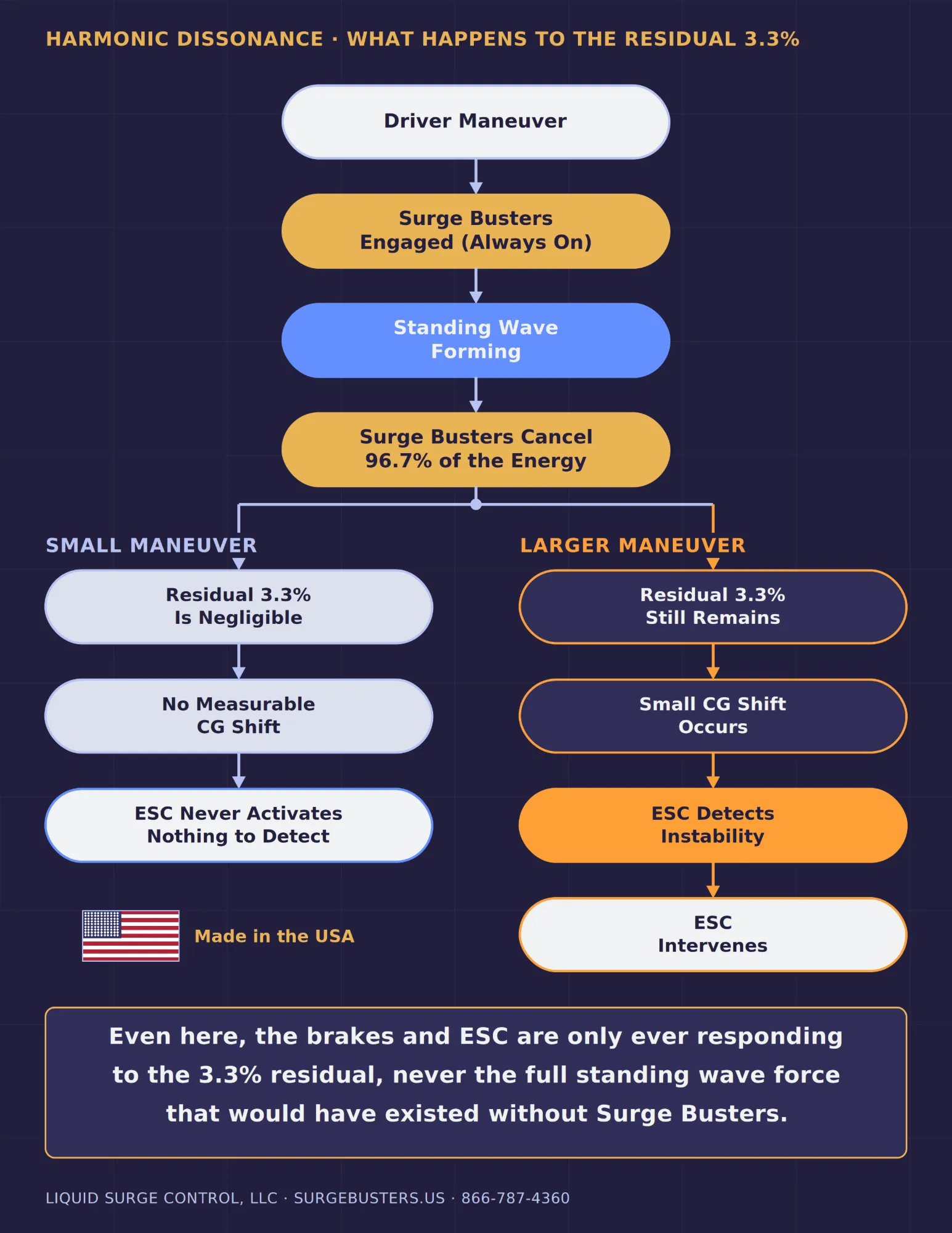
The 96.7% figure and the small-maneuver branch are Budwig's measured result. The 3.3% residual is simple arithmetic (100% minus 96.7%), not a separate claim. The larger-maneuver branch, and the ESC (Electronic Stability Control) response it describes, reflect how ESC actually works: heavy vehicle ESC is federally mandated under FMVSS No. 136 (49 CFR §571.136), detecting yaw rate and lateral acceleration against a threshold and intervening via differential braking when that threshold is crossed. What isn't independently measured or cited is the exact point at which this specific residual force crosses that threshold. That mapping is a reasoned illustration of the mechanism, not a separately measured test case.
This isn't a new idea. It's the same principle that's protected liquid fuel in spacecraft for sixty years.
→ See the full research and the invention-to-confirmation history: The Science Behind the 96.7%
Welded Baffles vs. Surge Busters
Welded baffles redirect force. Surge Busters remove it. Documented engineering data across five of the largest tank trailer manufacturers in the industry (Polar, Heil, Tremcar, Beall/Wabash, and MAC LTT) shows welded baffles reducing in-tank movement by 35% to 60%, depending on manufacturer and fill level. That's less liquid movement inside the tank, not less force reaching the truck: the force still transfers through the baffle into the tank shell, frame, and brakes instead, as Newton explains. None of it is eliminated.
Surge Busters, tested by the University of Idaho (2004), reduce the force itself by 96.7%. The cancellation math itself, floating elements oscillating out of phase and canceling each other's force, works the same way regardless of direction. The 96.7% figure is what that math produced in Budwig's tilt-table test, measured fore-to-aft. The exact percentage of side-to-side force has not been separately measured.
→ See the full comparison: Baffle Comparison
Eliminate Liquid Surge vs. Lowering Financial Risk
The alternative to eliminating surge isn't neutral, it's exposure. A single accident's financial, legal, environmental, and human costs can be severe enough to end a company outright on their own, and smaller incidents compound over time through insurance and litigation. See the full breakdown on What It Costs.
Liquid Surge Shouldn't Be an Ever-Present Threat
Beyond the 96.7%: Five More Ways This Pays Off
Driver retention, operational safety, transport capacity, maintenance, and ROI: five ways Surge Busters affect your bottom line beyond surge force itself.
Read the 5 Hidden Profit Points →Eliminating Liquid Surge Is Your Most Profitable Decision
Most companies hauling partially filled liquid loads are either avoiding the decision or don't realize surge can be reduced by 96.7%, at a cost far lower than the risk they're carrying. That reduction is exactly what Surge Busters do, researched at the university level.
Every day you run partially filled tanks without Surge Busters, you're operating at a verifiably higher level of risk: to your drivers, your equipment, and your business.
Repair Shops & Resellers Can Offer This Too
Repair shops get a genuine service opportunity (install through the existing access port, no welding, no special tools) and a measured 51.9% reduction in G-force reaching the frame, brakes, and suspension to point to. Resellers get a patent-backed differentiator, not a generic baffle ball, on units that are transferable between tanks.
→ See the full breakdown for both: For Repair Shops & Resellers