
Curious About Surge Busters and Plastic Tanks?
Every surge cycle that isn't eliminated has to go somewhere: repeated stress on the tank wall, cycle after cycle, for the life of the vehicle. That fatigue mechanism isn't unique to plastic, it happens in fiberglass, steel, and aluminum too. But none of these materials start from the same place, and none of them respond to repeated stress the same way.
The Material Difference
Poly (polyethylene, polypropylene, and similar plastics), fiberglass (FRP), and steel don't withstand the same amount of force. The published numbers below use polyethylene (HDPE), the most widely documented poly tank material, as the reference point: steel's yield strength is roughly 13 to 28 times higher. Fiberglass sits in between, closer to steel in raw strength, but its stiffness is still far short of metal.
There's a second factor beyond raw strength: stiffness (how much a material deflects under a given load), and it doesn't track strength in a simple line. Polyethylene's (HDPE's) modulus of elasticity is roughly 80,000 to 100,000 psi. Filament-wound fiberglass runs roughly 1.1 to 1.9 million psi, meaningfully stiffer than poly, but structural steel is still around 29 million psi, roughly 15 to 25 times stiffer than fiberglass. Fiberglass is a real step up from poly in both strength and stiffness. It is not a step up to metal.
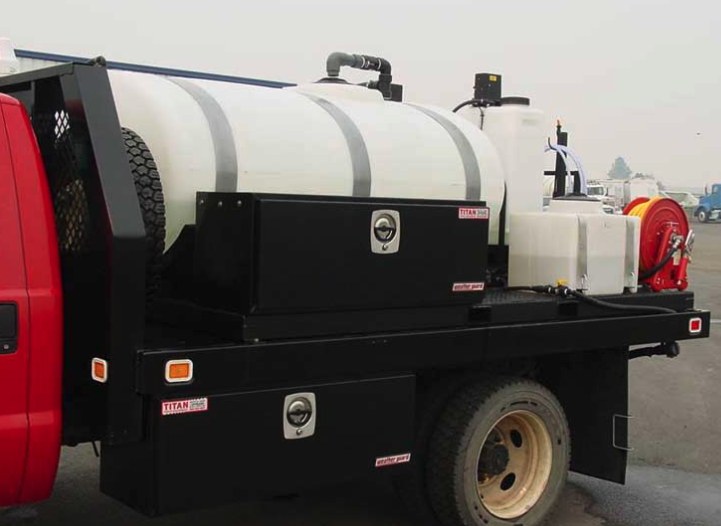
Poly has a third factor working against it that fiberglass doesn't share the same way: it's viscoelastic. Under sustained or repeated stress, poly creeps, permanently deforming, in a way neither fiberglass nor steel does to the same degree. A single hard impact is actually a case where poly's flexibility can work in its favor, it absorbs the hit and springs back rather than denting. But surge force isn't a single impact, it's repeated structural loading, the same stress cycling on and off, stop after stop, for the life of the vehicle. That's exactly the loading pattern where a much lower yield strength and a tendency to creep under repeated stress compound each other for poly specifically.
Yield strength and modulus figures reference polyethylene (HDPE) specifically, since that's the poly composition with published tank-material data; other poly types, like polypropylene, fall in the same general category (well short of metal on both strength and stiffness) but haven't been separately verified here. Steel figures are general published ranges for structural steel. Fiberglass figures are for filament-wound vinyl ester/glass construction typical of tank and pipe manufacturing; the wide range reflects real variation by winding angle, glass content, and load direction (hoop vs. axial), not measurement uncertainty. None of these are measurements of a specific Surge Busters-equipped tank. Viscoelastic creep under sustained or repeated stress is an established materials-science property of polyethylene, shared broadly across poly/polyolefin plastics.
How Repeated Stress Actually Cracks a Tank
Tank manufacturers themselves document this mechanism for poly: as a tank wall repeatedly flexes under load, cracks can initiate near stress points, fittings, mounting points, anywhere load concentrates, and with repeated stress, those cracks connect and grow until the tank fails.
Source: Poly Processing, "How Mechanical Stress Can Cause Tanks to Crack," blog.polyprocessing.com. Poly Processing is a rotomolded tank manufacturer; this is industry technical content, not an independent peer-reviewed study.
Fiberglass fatigues differently in kind, not just in degree. Steel fatigue is typically one crack that initiates and grows to failure. Fiberglass composite fatigue is a more complex, multi-mechanism process, matrix cracking, fiber breakage, fiber/resin interface debonding, and delamination, all can progress simultaneously well before a single dominant crack appears. That makes a direct "which one fails first" comparison between fiberglass and steel harder to state as a single number than the poly-versus-steel comparison above, the failure mode itself is different, not just the timeline.
Source: fatigue-damage-mechanism review literature for fiber-reinforced polymer composites (multiple published reviews describe matrix cracking, fiber breakage, interfacial debonding, and delamination as concurrent fatigue damage mechanisms in FRP composites, distinct from the single-crack-growth model typical of metals). General materials-science characterization, not a tank-specific or Surge Busters-specific study.
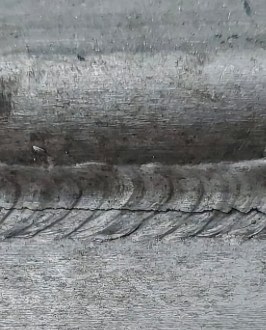
Metal tanks can absorb years of cyclic surge stress before fatigue becomes visible as cracking or failure. Poly tanks go through the same general fatigue process, but starting from a fraction of the yield strength and with a material that progressively deforms under repeated loading, so the life cycle from repeated surge stress to visible failure is measurably faster in plastic than in metal. Fiberglass sits in a different position: meaningfully stronger and stiffer than poly, but its fatigue failure mode is fundamentally different from steel's, so it doesn't reduce to the same simple "faster or slower" comparison. What's consistent across all three materials: reducing the cyclic stress that ever reaches the tank wall reduces fatigue risk regardless of which failure mechanism applies.
A Note on Repairability
Metal tank trailers can generally be repaired almost indefinitely; a damaged section can be cut out and welded back in. Fiberglass (FRP) tanks can typically be repaired as well, though with more limitations than metal. Poly tanks generally cannot be meaningfully repaired once cracked or ruptured; once the structure fails, replacement is usually the only option.
This is Gary Maurer's own professional observation from running a spray/agricultural equipment company, not an externally published finding. Stated here as field experience, not as a cited industry statistic.
What Surge Busters Change
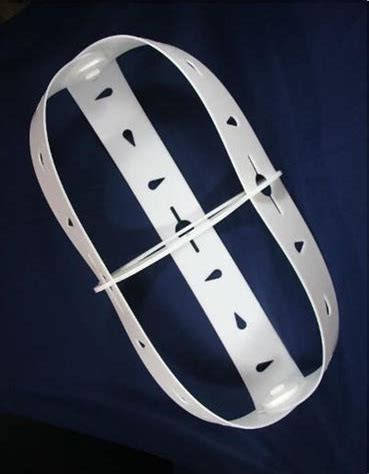
Surge Busters don't change any tank material's strength, stiffness, or fatigue behavior, nothing changes the material itself. What they change is how much cyclic stress ever reaches the tank wall in the first place. Preventing surge energy from organizing into a destructive wave means fewer full-force stress cycles hitting whatever material is carrying them. That matters for all three materials, but the gap between "matters" and "matters most" tracks the strength and stiffness numbers above: it matters most for poly (lowest strength, plus viscoelastic creep), still meaningfully for fiberglass (stronger and stiffer than poly, but still well short of metal, and fatiguing through a different multi-mechanism process), and least, though still real, for steel or aluminum.
Welded baffles don't help here. They redirect force into the tank shell rather than removing it, which does nothing to reduce the cyclic stress the tank material experiences over its service life.
Ready to Get Started
→ See the welded baffles comparison: Floating vs. Fixed Baffles
→ See the trailer-mounted tank application: Trailer-Mounted Tanks
→ See the independent research: The Independent Research Library
Order Surge Busters →